Wicked Problems and Systems Thinking
One aspect of my role as ICHK's Director of Creativity is the design of experiential learning which support ICHK's Human Technology curriculum. I'm always at my happiest when designing and making something new, especially if can accomplish the double-whammy of being very simple while making something complex a bit easier to understand.
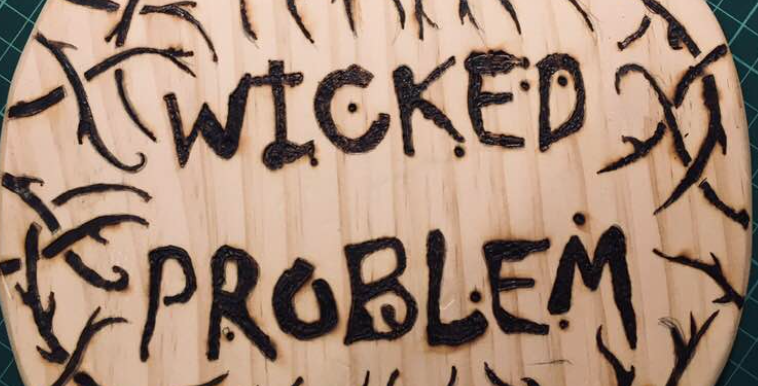
I want to share with you my latest game, which helps inexperienced systems thinkers get their heads around 'Wicked problems' and the all-too baffling yet fascinating interconnectedness of the systems that produce them.
If you like it please feel free to take it, play with it, adapt it, experiment, improve and let me know how you get on.
Here's a quick recap of what makes wicked problems just so damnably 'wicked'...

So 'Wicked problems' include, but are not limited to, environmental sustainability, Hong Kong's teen mental health crisis, the rich/poor divide and the inexplicable popularity of Justin Bieber.
The way we work at ICHK is informed by a sound understanding of the nature of complexity, best explained by Dave Snowden's Cynefin model:
Here's a quick summary of the four part Cynefin framework:
Simple systems have a clear order, wherein cause and effect exist in a predictable and endlessly repeatable way. We can apply 'best practice' in a simple system because we know what is going to happen. The procedures so loved by Hong Kong bureaucrats are parts of simple systems. They are safe, simple and reliable. They produce the same result time after time. These are great systems to work in if you have a low tolerance for uncertainty and a high boredom threshold.
Complicated systems have relationships between cause and effect, but, unlike simple systems, the relationships are not self-evident and require an analytical response if they are to be understood. We can apply good practice in a complicated system. A good analogy for this kind of system is a good, old-fashioned, wind-up wristwatch. It behaves quite predictably but, beneath the watch-face is a complicated sequence of interactions between many precise moving parts. A complicated system requires expertise to understand and operate in. How many of us have the skills of a horologist?
Complex systems operate without causality, wherein cause and effect are only evident in hindsight, with unpredictable, emergent outcomes. When we are engaging with a complex system we use emergent practice in response to the complexity. A good analogy for a complex system is the behaviour of a raincloud or the swimming patterns of a school of fish. Much of what we experience, day-to-day is complex because it involves human beings and the ways they have impacted the world. Human beings are highly complex, the systems they participate in are even more so.
Chaos - A situation where no cause and effect can be determined. Any practice within a chaotic system will be completely novel. This can be the home of innovative practice, or deeply undesirable.
The 'wicked-problem game is a more sophisticated twist on the standard outdoor-education activity which requires participants to stack tin cans using lengths of string attached to a central circle of bungee cord (Often called a 'bomb disposal' game).
In this game, the wicked problem (Whatever it is) sits at the centre of a group of sixteen players (See below).

Each player is given an aspect of a wicked problem (ie. Social isolation, underfunded social welfare systems, high academic pressure, social stigma etc) and the group is then asked to determine what the problem in the middle is (In this case, teen mental health in Hong Kong).
At this point players who don't have a string to hold (Or other facilitators) are guided by the 'Aspect-holders' to start clipping pre-cut length of bungee cords to loops in the 'Aspect' strings. Starting with obvious connections and becoming more subtle. This gives a visual representation of the interconnectedness of the various aspects and adds a strong feeling of tension to the emerging complex system. At this point someone will usually comment that "Everything connects to everything else", which of course it does. This connection phase of the game can be as simple or as complicated as time permits. The game takes on the appearance of a web and the tension of the strings can start for feel uncomfortable.
The facilitator of the game can then start to play with 'push/pull' factors and guide with questions like:
- What happens if everything gets worse for everyone? Everyone take one step back - The system becomes unbearably pressured.
- What happens if I solve/ameliorate these three problems? You three, take two steps forward. - The pressure comes off the system.
- What happens if I make these three problems significantly worse? You three...take five steps back - Some parts of the system feel more intensely pressured than others.
Participants quickly understand the inter-relatedness and complexity of wicked problems and can then begin to think about their intractability and the hope that they can, at best, be ameliorated, if not solved. It's a starting point for deeper investigations into a particular wicked problem.
My contention is that, as educators and facilitators, we should be encouraging understandings of the nature of complexity and wickedness, and be realistic but optimistic about our abilities to enact small changes, because, over time, they add up.